
Cicero Previous Residents by Era
No single Cicero source spans the whole life of a property. Current parcel facts establish the starting point; recorded documents take ownership backward; directories and census schedules add household clues. The most useful source depends on the year under study.
| Source | Years It Covers | Where Held | What It Shows |
|---|---|---|---|
| Clerk Recordings System | Online strength, 1985–present | Cook County Clerk | Recorded parties, dates, types, PINs |
| Cicero city directories | 1913; partial 1920–1945 | Cicero Public Library | Dated names, firms, and addresses |
| Cicero telephone books | Partial 1973–2018 | Cicero Public Library | Published name, phone, and address |
| Federal census | Public through 1950 | Library databases and archives | Households within an enumeration area |
| Permits and field cards | Series-specific | Town departments | Building work, applicants, property notes |
Start with the assessor and PIN even when the goal is historical. For a late twentieth-century trail, search the deed index and telephone books. For an early house, expect directory gaps, census work, maps, newspapers, and offline deed books.
The sources also describe different roles. A grantee acquired a recorded interest. A taxpayer field may carry a mailing name. A directory printed a name supplied or gathered for that edition. A census enumerator recorded a household at one point in time. Put an “owner,” “occupant,” “mail recipient,” or “uncertain” label beside each name rather than blending all hits into one list of previous residents.
Start Cicero History With PIN
Search the Cook County Assessor by address and save the 14-digit PIN. The parcel page can show assessment values, class, characteristics, and a property-location string. It does not prove who occupies the place. The Assessor warns that property location is not a legal or postal mailing address.
Keep four fields apart: physical location, taxpayer mailing address, legal description, and the form printed in a directory. A mismatch is a prompt to investigate, not an error to erase. Then open CookViewer to confirm parcel geometry and nearby lots.
Search Cicero Recording Panels
The advanced Clerk Recordings search accepts combinations of PIN, legal description, grantor, grantee, document number, type, and date. Use the PIN first, then add names from each deed as the chain develops.
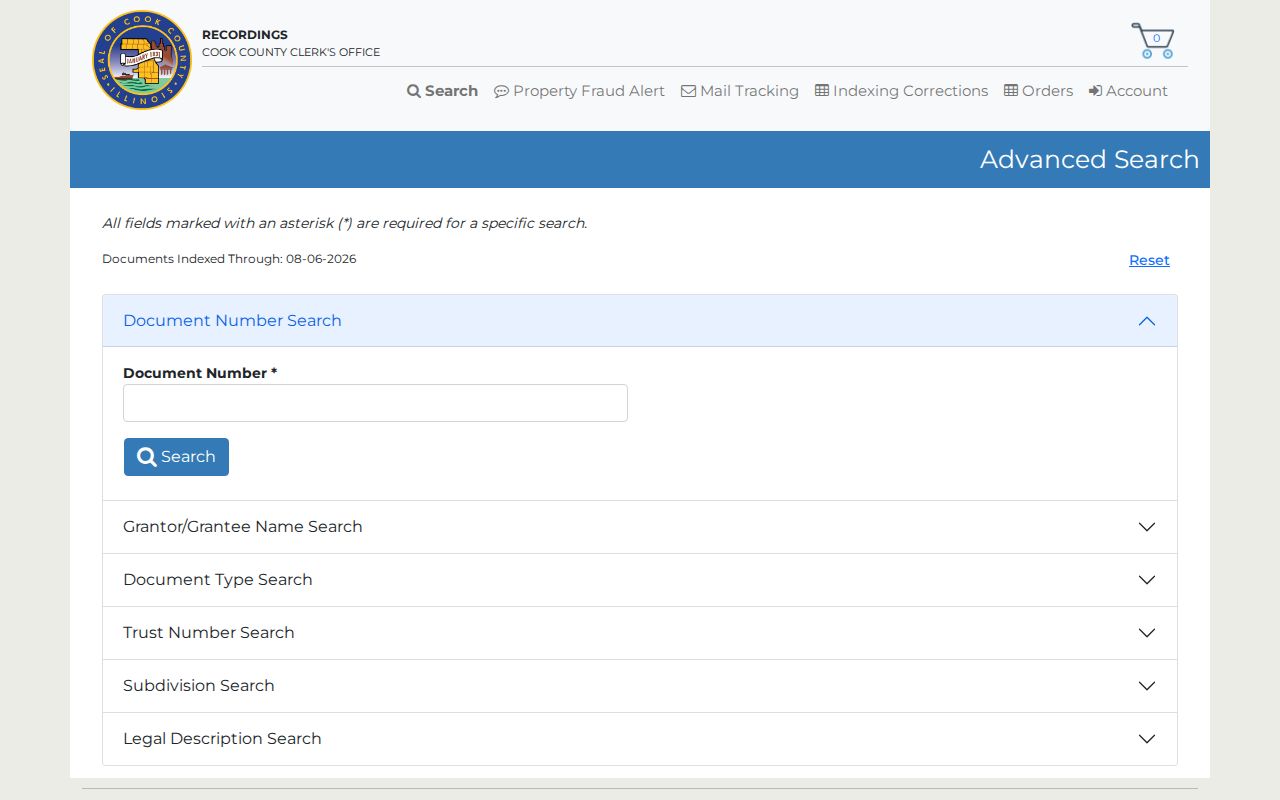
The captured panels show why a backward search can continue even when a street address changes.
A results page lists document numbers, recorded and executed dates, types, first parties, associated documents, and the first PIN. That is an index, not the final proof.
Use both recorded and executed dates in the timeline. A deed can be signed before it reaches the Clerk. Search correction and associated-document links when a party spelling or legal description changes. Mortgages, releases, liens, easements, plats, and notices may explain the parcel record, but they do not each mark a change in ownership or occupancy.
Trace Cook County Deeds Backward
A chain of title is the sequence of recorded transfers affecting a parcel. Begin with the newest supported owner or deed, then move from the buyer on one transfer to that person's earlier purchase. Dates, document types, PINs, and legal descriptions help prevent same-name mistakes.
- Copy the PIN and legal description from the current parcel sources.
- Find the newest purchase deed and record its parties, dates, type, and number.
- Search the seller as an earlier grantee to locate that party's purchase.
- Repeat, checking corrections, releases, mortgages, and associated documents without treating each as a sale.
- For pre-1985 gaps, use downtown tract books, the counter, IRAD, or a qualified title researcher.
- Grantor / grantee
- The party giving an interest and the party receiving it.
- Chain of title
- The linked sequence of recorded interests for one parcel.
- Legal description
- Land wording based on lots or survey units that can outlast a street number.
The captured results layout shows the index columns used in the chain.
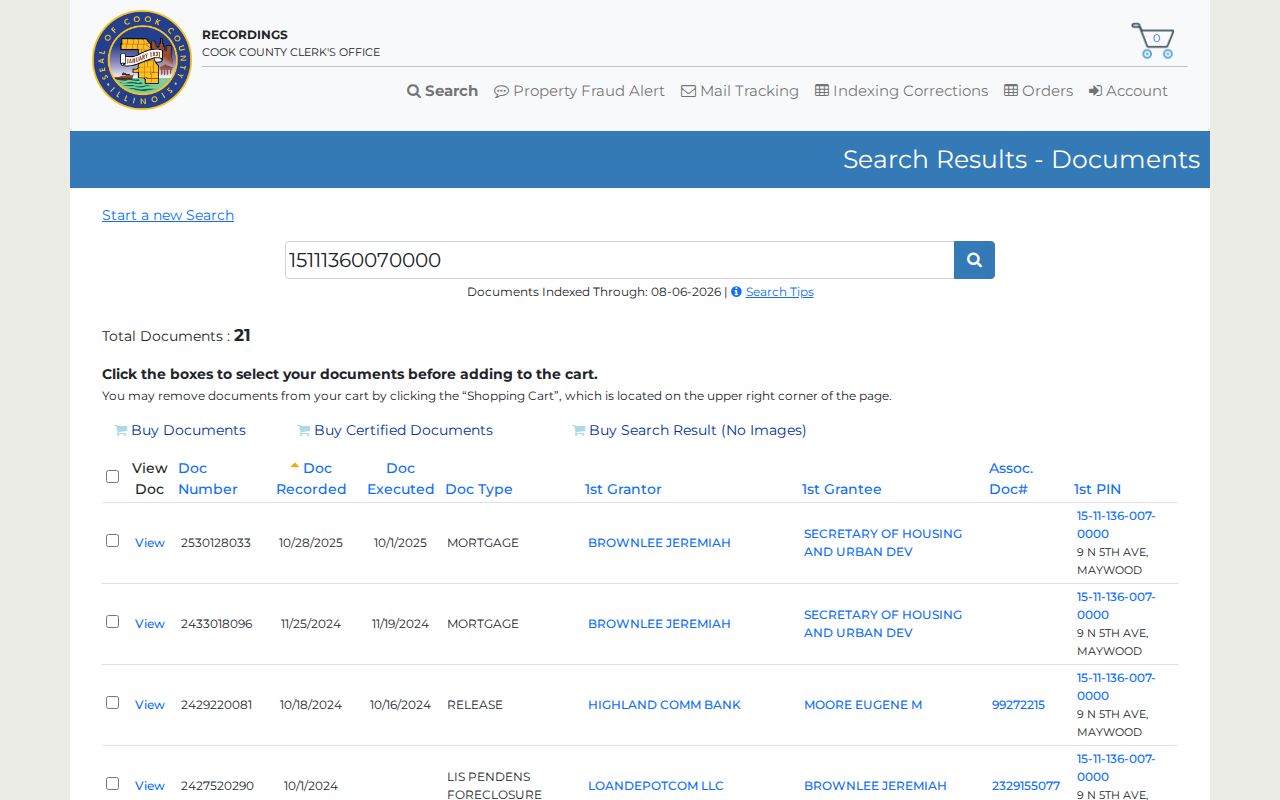
Sortable rows make a timeline easier, but the image or certified copy remains the stronger record.
Pre-1985 work often moves offline. Clerk Recordings has a downtown counter and tract books arranged by subdivision, while selected Cook County land and tax series are described through IRAD. Telephone, mail, and office help are valid access channels when the online index stops. A complete legal chain may call for a title professional, but a personal house-history log should still cite the exact book, page, reel, or document number found.
Read Cicero Deed Details
A Clerk detail page can show document number and type, execution and recording dates, page count, consideration, parties, address text, and a legal-description table. The table may include PIN, section, township, range, subdivision, lot, block, and unit. Preserve the labels as printed.
The captured recording detail layout illustrates those fields with a non-Cicero layout sample.
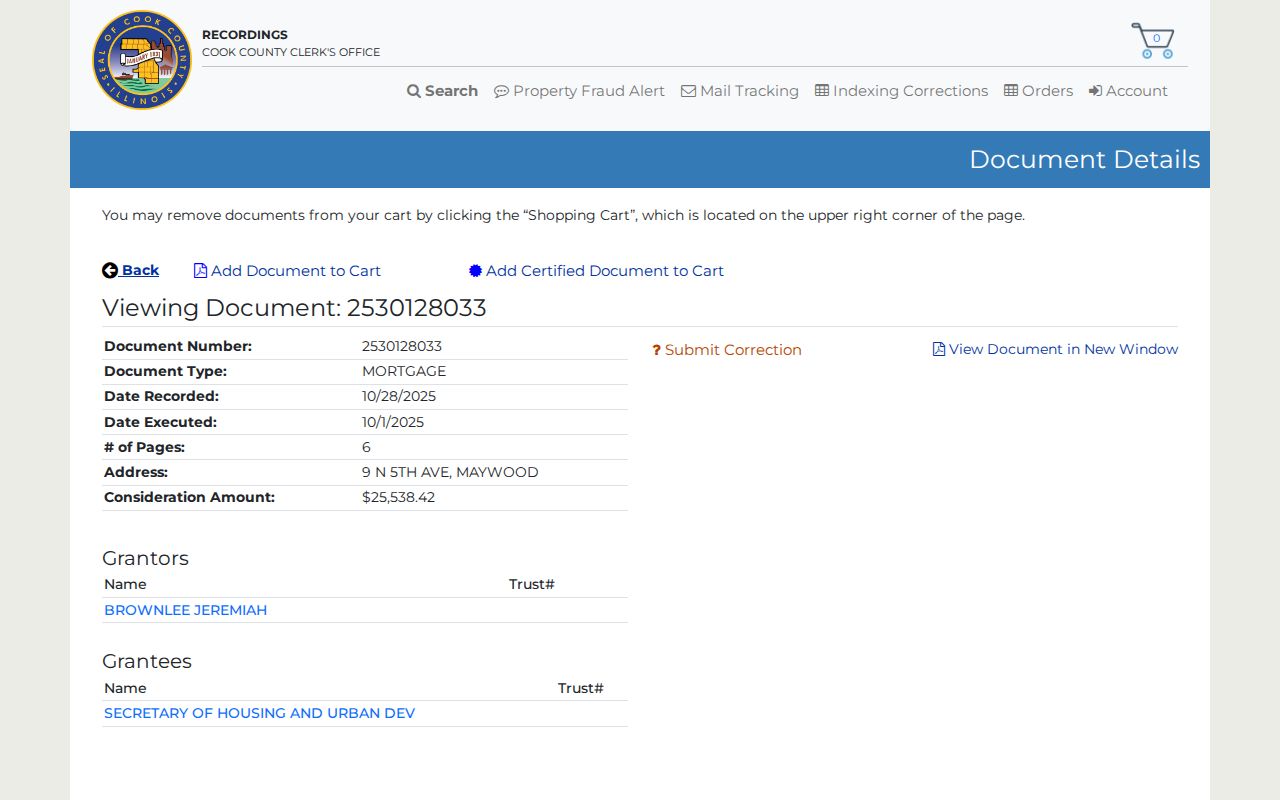
The sample proves the portal structure only. It must not be presented as evidence about a Cicero household.
Some document classes, including certain plats, easements, dedications, and annexation materials, may appear in the index but not be available for online purchase. Contact Clerk Recordings or visit the counter for the current copy route. Fees can change, so verify the live schedule rather than carrying an old amount into a research note.
Compare Cicero Directory Years
The Cicero Public Library house-history workflow pairs the Assessor and deed index with permits, census records, directories, newspapers, and maps. Its Local History Room holds the 1913 directory, a partial 1920–1945 run, and partial telephone books from 1973–2018. Missing editions mean that absence from one year is weak evidence.
- Choose a directory year closest to an available public census.
- Record every printed name, role, street form, page, and edition.
- Locate the census enumeration district and compare the household, not just one surname.
- Check the nearest directory years and local newspapers for moves, deaths, firms, and relatives.
Research-room visits are by appointment. HeritageQuest is available remotely with a Cicero card, while Ancestry Library Edition is used in the library. The latest public decennial census is 1950 under the federal 72-year rule.
For every directory hit, record the title, year, publisher if shown, page, printed street spelling, house number, name, occupation or business, and any moved notation. Then check the year before and after when available. The library documents missing volumes, so never assume that a person stayed through a gap. A telephone listing is also a dated publication, not proof of title or continuous residence.
Local newspapers widen the trail. Cicero Life runs from 1933 to 2013 in the library holdings, while other local runs are incomplete. Search the full address, street without suffix, surname variants, institutions, and nearby intersections. Optical character recognition can misread old type, so verify each hit against the page image or microfilm.
Map Cicero Building Changes
The 1918 Library of Congress Sanborn volume includes Cicero among the covered places. Sanborn sheets describe buildings, lots, construction, industrial sites, and street layout. They are not resident lists. Compare a sheet with deeds, directories, and permits to learn whether the same numbered place was physically the same structure.
Town field cards, transfer sheets, plans, permits, and inspection records require a counter inquiry or focused public-records request because no public address database was found. A building change can explain a gap in past-resident records, but a permit applicant should not be labeled an occupant without another source.
Architectural facts can resolve an apparent contradiction. A parcel may once have held a different structure, a storefront may have been converted, or an addition may explain a new unit label. Compare the map date with the permit date and directory edition. Keep the building conclusion separate from the people conclusion unless a source expressly connects them.
Cicero Boundaries Shift the Trail
Cicero organized in 1857 and once covered 36 square miles. Chicago annexations, Austin's 1899 change, the 1900 Stickney transfer, and the 1901 separation of Oak Park, Berwyn, and Cicero explain why an old “Cicero” reference may fall outside today's Town. Search the historical jurisdiction as well as the modern address.
No complete official Cicero street-renumbering table was located. Preserve every spelling and number variant, then test it against plats, Sanborn maps, field records, and two or more dated publications. Boundary history is an explanation to test, not permission to merge two parcels.
County history adds another caution. Cook County was created in 1831, and Chicago remains the county seat, so many Cicero land and court records are held outside the Town. The separate Recorder office ended in 2020 when its duties moved to the County Clerk. An older citation to the Recorder and a current Clerk Recordings request can refer to the same custodial line.
Cicero Past Household Proof
Owners are only one layer of previous-residents research. Dated directories and telephone books can place a published name at an address; census schedules can show household structure; newspapers, yearbooks, and obituaries can connect relatives and life events. The source year must travel with every name. The Cicero city directory collections are described separately so their gaps and access rules remain clear.
Obituaries and probate files can close a trail after a person leaves or dies. Probate is a countywide court division, and an online docket is only a summary. Older court files may also be affected by the 1871 fire and burnt-record series held through IRAD. Ask the court clerk or archive for the file route, and distinguish a docket reference from an official paper record.
IRAD accepts in-person, mail, and telephone research requests, but not email research requests. Cicero Library reference staff can help identify a volume or newspaper run before an appointment. These fallbacks matter when nothing has been digitized.
Lawful use. Trace Cicero previous residents for house history, genealogy, and lawful personal research. Never use the trail to harass or track a living person.