
Walk a Cicero Street Record
A Cicero street directory search works as a chain, not a name roster. Start with the exact place, identify the parcel, and separate ownership from occupancy. The Cook County Assessor identifies a parcel and its 14-digit Property Index Number, or PIN. CookViewer shows parcel shape and nearby lots. Clerk Recordings ties the PIN to recorded interests. Library sources add dated clues about people linked to an address. Illinois voter tools verify an individual's own registration; they are not open street rosters.
- Standardize the address through USPS, keeping the unit, direction, suffix, city, and ZIP.
- Search the Cook County Assessor and copy the PIN exactly.
- Select the parcel in CookViewer before comparing nearby lots.
- Search Clerk Recordings by PIN, then inspect deeds, parties, dates, and legal descriptions.
- Check dated directories, phone books, census material, and newspapers for past occupants.
Write the source date beside every result. A tax mailing field, directory entry, and deed party may name different people for sound reasons. Together they form a useful address record without turning a tentative match into a claim of residence.
Normalize Cicero Street Addresses
Use the USPS ZIP Code Lookup to standardize the current mailing form before searching by street. USPS asks for street, city, and state, with company, unit, and ZIP as added fields. Its result does not confirm that anyone occupies the site. For Cicero, 60804 is the verified starting ZIP, but a ZIP line does not prove a parcel is inside Town limits.
Older records demand more care. Cicero once covered a broader area, and boundary changes from 1857 through 1901 can make the historic place name wider than modern Cicero. No official townwide renumbering table was found. When an old number fails, compare adjacent directory years, a plat, Sanborn sheet, field card, and newspaper references.
Search Cicero Assessor Fields
The Cook County Assessor address search is the strongest first official index for a Cicero street directory. The public form has no universal owner-name box. Search the place and carry its PIN into the map and recording systems.
| Mode | Field | Use | Format |
|---|---|---|---|
| PIN | PIN number | Exact parcel | 14 digits and CAPTCHA |
| Address | House number | Site or range | Start required; end optional |
| Address | Direction | Narrow repeats | N, S, E, W, NE, NW |
| Address | Street name | Find by street | Omit Ave., St., or Pl. |
| Address | City | Limit results | Enter Cicero |
The Assessor advanced search shows further parcel criteria.
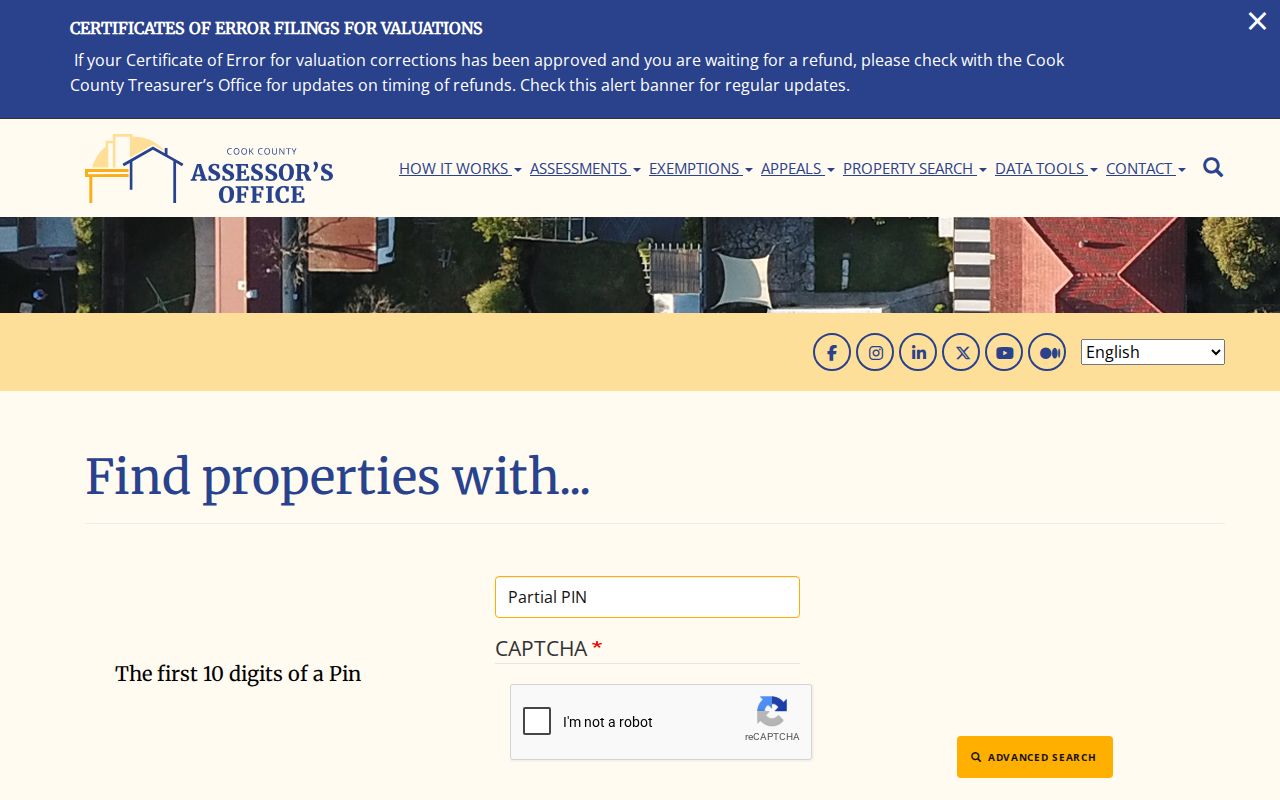
The captured form confirms that an address lookup depends on official fields, not a resident-name query.
Read Cicero Parcel Details
A parcel page may show PIN, class, values, characteristics, exemptions, and a property-location string. Those facts describe an assessment record, not every person at the site. The Assessor warns that “Property Location” is not a legal or postal mailing address.
The official Cicero sample parcel shows the record layout.
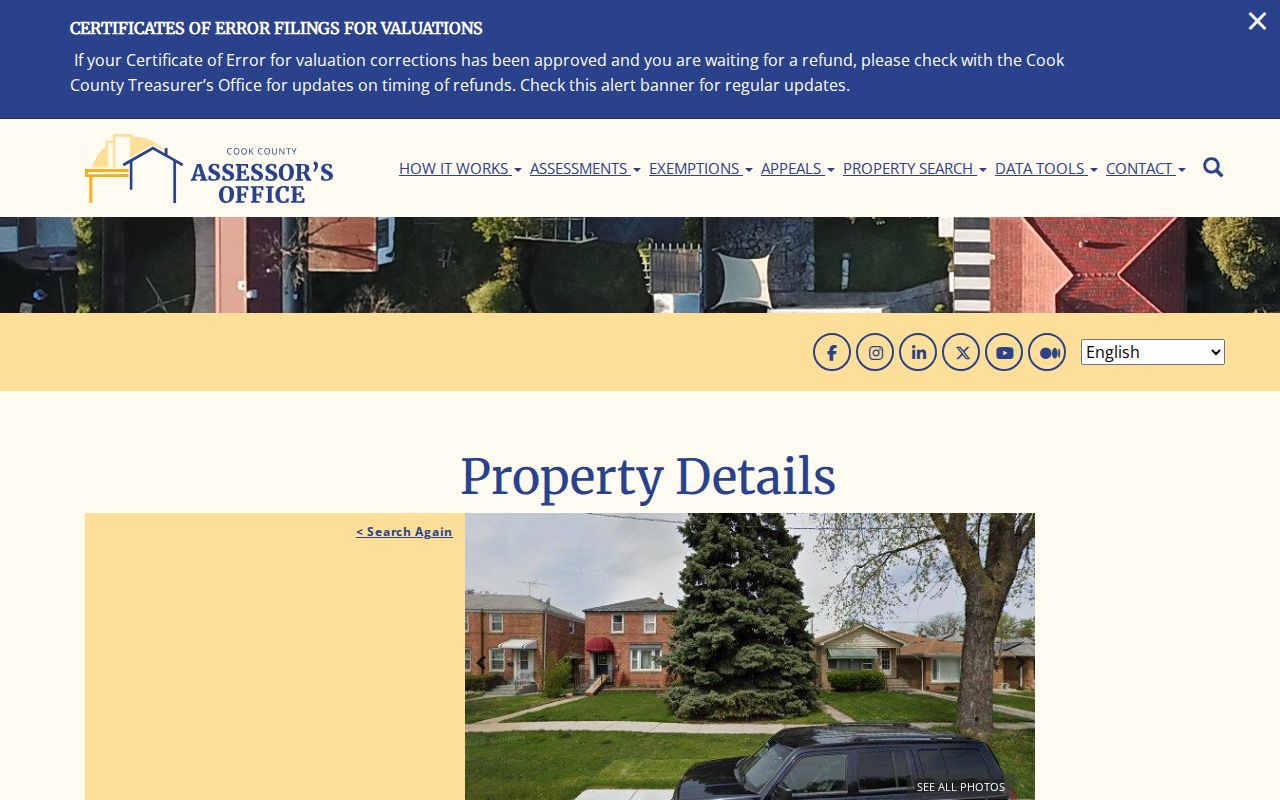
Keep property location, mailing address, legal description, and directory address in separate research fields.
- Parcel
- A mapped piece of land identified by a PIN.
- Situs address
- The location used to place property on a map.
- Plat
- A recorded map of lots, blocks, streets, and alleys.
- Criss-cross directory
- An address-ordered directory rather than a surname-only list.
Map Cicero Streets in CookViewer
CookViewer accepts parcel, PIN, address, and intersection searches. Select a parcel before opening details, Nearby Search, comparisons, and map reports. The nearby tool needs a source parcel first, so it is not a free-floating resident-radius search.
The captured CookViewer address query demonstrates the map search.
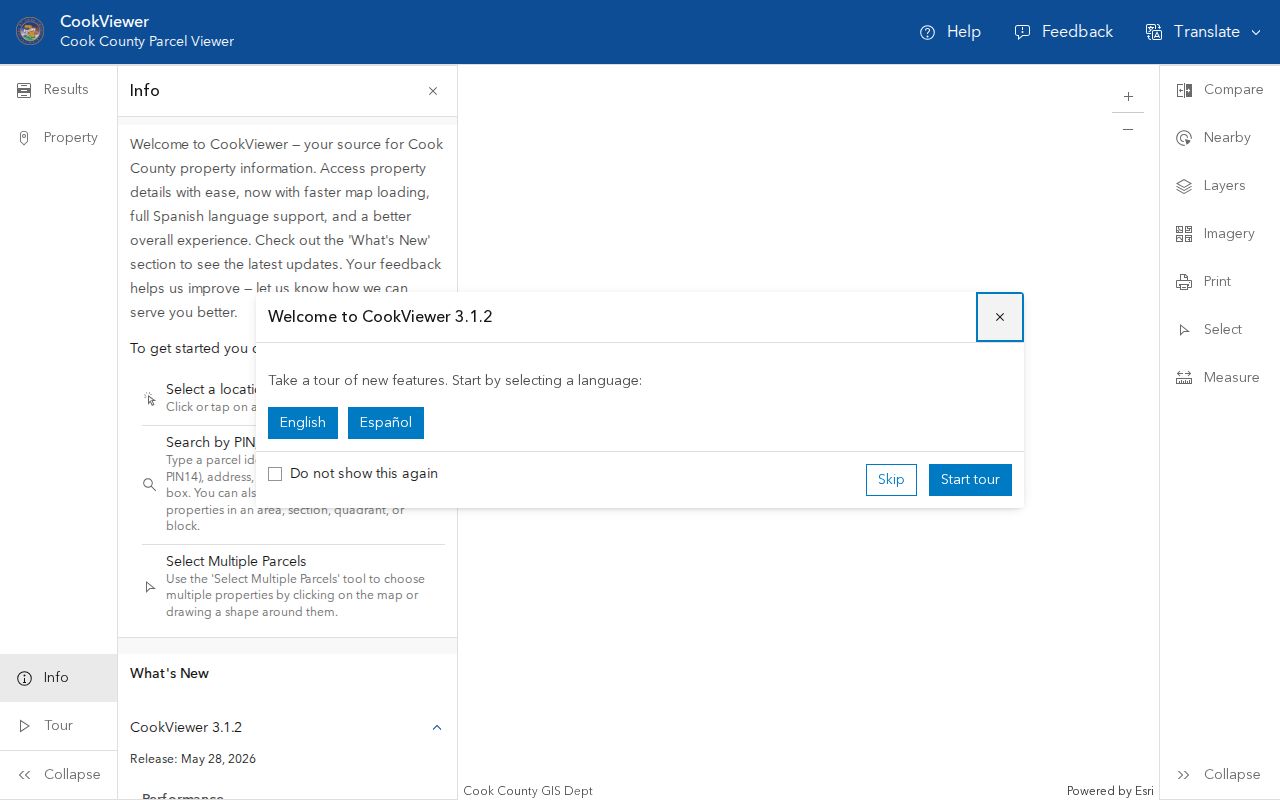
The map separates corner lots, alleys, and adjacent PINs. Adjacency is a parcel fact, not proof that people know one another.
Cook County reports that its GIS program dates to 1987, with countywide parcel data completed in 2004. The system now maintains more than 1.8 million parcels and about 12,000 miles of street centerlines. Those figures explain why the parcel layer and the road layer should be checked together. A search label may land near the right place while the selected polygon identifies a different tax parcel. Always copy the PIN from the selected feature, then compare it with the Assessor result.
The official viewer also lists separate contacts for Cook County GIS, the Assessor, Clerk Maps, and Clerk Recordings. Send a map-layer or geometry question to GIS. Assessment fields belong with the Assessor. Recorded plats and map copies route through Clerk Maps, while deeds and other instruments route through Recordings. This division matters when a Cicero street directory search reaches an alley, subdivision line, easement, or lot split that the ordinary address label does not explain.
A new CookViewer application release was announced on May 28, 2026. Treat controls and screen placement as current interfaces that may change, while the saved PIN, source URL, retrieval date, and printed report preserve the substance of a search. For a street-by-street project, record each parcel separately. Do not infer that the next house number is the next parcel, especially at corners, multiunit buildings, commercial frontage, or lots divided by an alley.
Cicero Street Records by Address
Each source answers a different question. This by-address table separates parcel facts, recorded interests, local files, and dated historical entries. None is a complete occupancy roll.
| Record Set | Keeper | What It Shows | Access |
|---|---|---|---|
| Assessment parcel | Cook County Assessor | PIN, location, class, values | Web search and office |
| GIS parcel map | Cook County GIS | Shape, nearby lots, map detail | Free CookViewer |
| Recorded documents | Cook County Clerk | Deeds, liens, plats, parties, dates | CRS, paid copies, counter |
| Town files | Town Assessor and Building Department | Field cards, transfers, permits | Counter or focused FOIA |
| Historic sources | Cicero Public Library | Dated directory and news clues | Appointment and databases |
The PIN joins assessment and GIS records to the deed index. Street text helps locate permits and publications. Illinois election law prevents the voter system from serving as an unrestricted street directory and requires sensitive fields to be redacted.
Follow Cicero Deeds by PIN
The Cook County Clerk Recordings System searches recorded documents by PIN, legal description, party, number, date, and type. Results show executed and recorded dates, document number, first grantor and grantee, associated document, and first PIN. A grantor gives an interest; a grantee receives it.
Online retrieval is strongest from 1985 forward. Earlier Cicero street research may require downtown tract books, the Recordings counter, IRAD, or a title researcher. Some plats and maps cannot be bought online. Address text in CRS is only informational, so confirm the PIN, legal description, and image before linking a document to the parcel.
Search the document types with care. A warranty deed, quit claim deed, trustee's deed, mortgage, release, lien, easement, and plat each reflects a different event. A mortgage does not show a new occupant, and a release does not prove that someone moved. Corrections and associated document numbers may explain why the same transfer appears in more than one row. For each useful result, log the recorded date, executed date, number, type, first parties, PIN, and link to the source.
The former Recorder of Deeds was consolidated into the Cook County Clerk on December 7, 2020. Older citations can still say Recorder, while current requests go to Clerk Recordings at 118 N. Clark Street, Room 120, Chicago. Phone and email contact are useful when a document cannot be bought through the web portal. Mail and copy-order routes also remain available under current Clerk instructions.
Request Cicero Field Records
The Town Assessor keeps field map books, transfer sheets, master field sheets, permit data, and field cards. No online public index was found. Start with the counter or a focused Illinois FOIA request that gives the address, PIN, file type, and date range.
Building files can explain an addition, storefront, demolition, or inspection. Preserve the role stated in each record. A permit applicant is not always the owner or occupant. FOIA reaches nonexempt public files but does not override privacy and safety limits.
A tight request names the street number, all known variants, the desired permit or inspection type, and a reasonable date span. Ask whether a field card, transfer sheet, master sheet, or map-book reference exists. If staff supplies only a file number, retain it for the next request. These local records can bridge the gap between the county parcel and a building's physical history without claiming that every named applicant lived there.
Date Cicero Street Directory Clues
The Cicero Public Library Local History Room holds a 1913 city directory, a partial 1920–1945 run, partial telephone books from 1973–2018, and local newspapers. Research is by appointment, and gaps are documented. Ask whether an address-ordered volume exists before describing one as a criss-cross directory.
Log the edition, page, printed street form, number, name, and role, then compare the closest years. The collections themselves belong on the Cicero city directory page; here they provide dated address clues. Remote paths include HeritageQuest with a Cicero card, while IRAD accepts mail and phone requests but no email research requests.
The library also holds Cicero Life from 1933 to 2013, an incomplete Suburban Leader microfilm run, partial Cicero Town News, and school yearbooks with gaps. Newspapers can place a sale notice, meeting, business, or family event on a street. A yearbook can connect a name to a school year but not prove a home address. Cite the publication, date, page, and exact wording so another researcher can repeat the search.
Sanborn fire-insurance maps add building shape, lot use, construction, and street-layout context. The Library of Congress has a 1918 Cook County volume that identifies Cicero among the places covered. A map contains no resident roll. Its role is to show whether the building, lot, or street form seen in a directory matches the place shown in that era.
Cicero Street Directory Limits
A Cicero street directory cannot prove who lives at a place today. Assessment pages concern parcels, deeds concern recorded interests, and old directories are dated publications. A mailing name can differ from the person at the site. Voter data carries statutory use limits and redactions. Driver information is protected by federal law, and Illinois public-records exemptions protect private or safety-sensitive details.
Illinois Address Confidentiality Program participants may use a substitute address. The program does not erase every old public record. Minimize details about living people, and never republish a current address trail merely because a historic source contains it.
A negative search is not proof that nobody lived there. The street may have a variant spelling, the unit may be omitted, an edition may be missing, an image may not be indexed, or the parcel may have crossed a historic boundary. State the scope of the search, including the source and date range, instead of turning silence into a fact.
Lawful use. Use Cicero address records for lawful personal research. Never use them to stalk, harass, threaten, or expose a protected person.